Blue Collar Smart logo
← All podcast guests

Blue Collar Smart Guest

Robert Darling

Retired USMC Lt. Colonel, President & CEO of Flash Emergency Management

He flew Cobras in Desert Storm and spent September 11, 2001 in the bunker beneath the White House. Now he helps small businesses find what could take them out.

Robert Darling

Background

About Robert

Crisis LeadershipRisk MitigationBusiness ContinuityDecision MakingEmergency ManagementPublic Speaking

Robert Darling retired from the United States Marine Corps in October 2007 after just over twenty years of active duty. He flew attack helicopters in Desert Shield and Desert Storm during the first Gulf War, and in Somalia in support of Operation Restore Hope. In June 1998 he was selected to fly as a presidential pilot with Marine Helicopter Squadron One, and in October 2000 he was handpicked for the White House Military Office, Airlift Operations Department. On September 11, 2001, he supported the President, Vice President and National Security Advisor in the President's Emergency Operations Center beneath the White House.

Darling is the author of 24 Hours Inside the President's Bunker, 9/11/01: The White House, and speaks on crisis leadership and decision making to academic, government and military audiences, including Harvard University's John F. Kennedy School of Government and the FBI National Academy at Quantico, where he has guest lectured on crisis leadership and counterterrorism. Today he is President and CEO of Flash Emergency Management, a crisis leadership training and technology company in Stafford, Virginia, where he works with small and mid-sized companies to map their risks and build a path back from disruption.

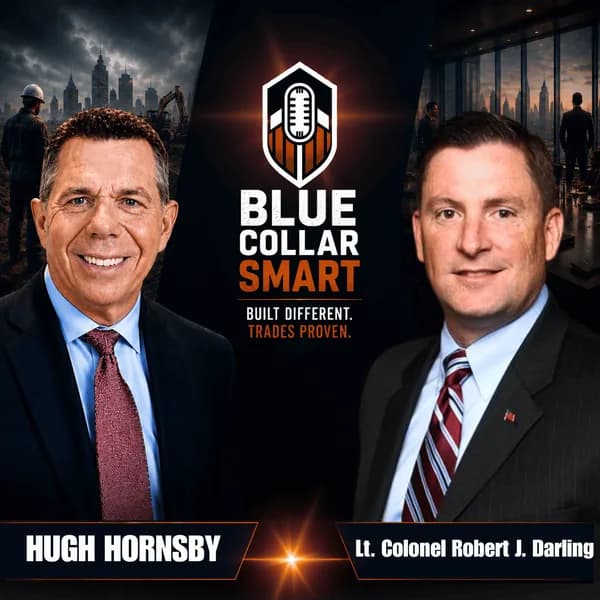
On Blue Collar Smart, Darling and Hugh Hornsby traced the line from a Newburgh, New York hockey family to a Cobra cockpit to the emergency operations center under the White House. The conversation covers what great leaders actually do when the plan breaks — compartmentalization under pressure, what Condoleezza Rice did in the bunker, why the country is turning to plumbers, carpenters and electricians to fill its resilience gaps, and why the owner still standing after a disruption has an advantage over every competitor who wasn't ready.

Key Insights

What Robert brings to the conversation.

01

Compartmentalization is the skill under every other skill.

Quantico taught Darling to stop carrying the last event into the next one. The rifle test is over; forming up is now the most important thing. Under pressure, handle the immediate threat first, then orient, then communicate — and leave the previous failure where it happened.

02

Aviate, navigate, communicate works on a job site too.

When his wingman flew a Cobra into a sand dune at night, Darling flew the aircraft first, figured out position second, called for help third. In business that means naming what has to be accomplished first, second and third, telling your people, forming a plan, and moving.

03

In a crisis, your title is irrelevant and proximity to the problem is everything.

The most vertical chain of command in the world went flat on 9/11. National Security Advisor Condoleezza Rice sat next to Darling and asked what he needed — water, food, or a call to a world leader. The senior person made herself useful to the people closest to the problem.

04

You don't need to be the expert at everything. You need a cabinet.

A president doesn't know everything; a president builds a cabinet. Darling's point to owners is that a welder trying to also be the accountant and the leadership expert is burning the candle at both ends. Pick two or three outside specialists and build around your actual expertise.

05

Treat every employee as a sensor, and put people before profits.

The person on the truck sees the bald tires, the unhappy customer, and the hazard that becomes a lawsuit. Darling argues the customer is the wrong answer to who matters most in your company. Make flagging problems normal and rewarded, before they escalate.

Featured Conversation

How Great Leaders Think in a Crisis with Lt. Colonel Robert J. Darling

Episode 14 · October 15, 2026

How Great Leaders Think in a Crisis with Lt. Colonel Robert J. Darling

Robert Darling, author of 24 Hours in the President's Bunker, on compartmentalization, crisis leadership, and why resilience is a competitive advantage.

Listen + Read

Continue the Conversation

Connect with Robert.